


Wire cutting stripping machine applications in automotive and electronics manufacturing
 Oct 21, 2026|
 View:4
A wire cutting stripping machine plays an essential role in automotive wire harness production. The same equipment anchors electronics connector and cable assembly lines. Automotive work depends on precise preparation for harnesses, sensor wiring, and EV high-voltage wiring. Electronics production relies on the same accuracy for PCB assembly, connector wiring, and internal device cabling. Each application places different demands on cutting precision, stripping quality, and wire range. Shared benefits link these industries too. Both sectors gain from consistent output, faster cycle times, and lower labor costs. Practical selection criteria help readers connect each application to the right equipment decision. Wire size, insulation type, and production volume guide that choice.
Key Takeaways
Wire cutting stripping machines cut wire to exact lengths and remove insulation cleanly. This precision prevents errors in later production steps.
Automotive manufacturing uses these machines for harnesses, sensor wiring, and EV high-voltage cables. Electronics manufacturing uses them for PCB assembly, connector wiring, and internal device cabling.
Both industries gain from faster production, lower labor costs, and less waste. Automated machines also improve safety and scalability.
Choose a machine based on wire size, insulation type, and production volume. Match the machine's capabilities to your specific application for the best results.
Consider total cost, including maintenance and compliance. A well-built machine may cost more upfront but saves money through reliability and uptime.
Wire cutting stripping machine basics
Core functions
A wire cutting stripping machine performs two jobs with high accuracy. It cuts wire to a set length. It then removes insulation from the ends without nicking the metal core. These two steps define the quality of every downstream connection.
The equipment handles a broad range of work. Wire sizes span delicate 0.1 mm² signal wires up to heavy 240 mm² power cables. Length tolerance stays within ±0.5 mm to ±1.0 mm on many models, and strip tolerance reaches ±0.3 mm as a standard. Cutting lengths can reach up to 100 meters, while strip lengths range from 1 mm to 50 mm. Production volume scales from prototypes to millions of pieces.
Parameter | Typical Specification |
|---|---|
Wire Range | 30 AWG to 4/0 AWG |
Length Tolerance | ±0.5 mm to ±1.0 mm |
Strip Tolerance | ±0.3 mm standard |
Max Cutting Length | Up to 100 meters |
Strip Length | 1 mm to 50 mm |
Automatic machines rely on motors and sensors to do this work. Motors drive the blades and feed the wire. Operators set length and size on a control panel, and the machine executes the rest. Sensors watch the wire as it passes through and stop the machine immediately if something goes wrong. This protection prevents damage to the wire core and safeguards both the user and the equipment. The result is fast, repeatable stripping with fewer errors and less waste than manual tools.
Role in production lines
In harness automation, the machine sits early in the sequence. It prepares wire before crimping, sealing, and testing stations. Accurate cuts and clean strips at this stage keep later operations running smoothly. Poor preparation at the front of the line creates defects that appear much later.
The machine also supports flexible production. Operators can switch between wire sizes and strip lengths quickly through digital controls. This flexibility helps lines handle mixed orders without long changeover delays.
Automotive wire cutting stripping machine applications
Harnesses and electrical systems
Automotive harness production demands tight control over every cut and strip. A wire cutting stripping machine prepares each lead before it moves to crimping, sealing, and testing. Length accuracy matters most on short leads. Shops typically hold ±1 mm on short leads, or ±0.5% on longer runs, and they verify it through automated measurement with sampling. Strip length follows a tighter rule at ±0.3 mm, checked by visual inspection plus a go/no-go gauge.
Operation | Precision Requirement | Verification Method |
|---|---|---|
Wire cutting (length) | ±1 mm for short leads, or ±0.5% | Automated measurement with sampling |
Wire stripping (length) | ±0.3 mm | Visual inspection plus go/no-go gauge |
Stripping must remove insulation to the exact depth without nicking the conductor strands, since damaged strands can cause field failures.
Modern harness lines merge several steps into one flow. Integration combines wire feeding, cutting, stripping, crimping, sealing, testing, bundling, and labeling into a continuous workflow. This flow delivers higher crimp consistency, better traceability, and lower labor costs. It also supports both low-voltage and high-voltage EV cable production up to 400 mm². Each upgrade removes a specific manual error source: cutting and stripping to length, crimping to a verified force, sealing where required, and testing before shipment. Harness lines carry safety-critical circuits, so crimp-force monitoring and in-line fault detection matter as much as raw throughput. The highest-impact upgrade combines cutting, stripping, and crimping in a single automated cycle with built-in quality monitoring.
Sensor and EV high-voltage wiring
Sensor wiring leaves little room for error. A nicked strand or a short strip can distort a signal or break a connection inside a dense harness. Car plants therefore demand extremely exact work on these small-gauge leads. EV high-voltage wiring raises the stakes further. Battery pack cables carry large currents, and their insulation must come off cleanly across a thick wall. EV battery wire processing is a growing use case, and it pushes equipment toward larger wire ranges and repeatable strip depth.
Large-cable models serve this work. The HECHANG HC-608L2 handles big cables up to 120 mm², the HC-608XL reaches 150 mm², and the HC-608EX processes cables up to 240 mm². These examples show where each model fits best, not a ranking. A shop running mostly sensor leads needs different capacity than a plant building battery packs.
Electronics manufacturing applications
PCB and connector wiring
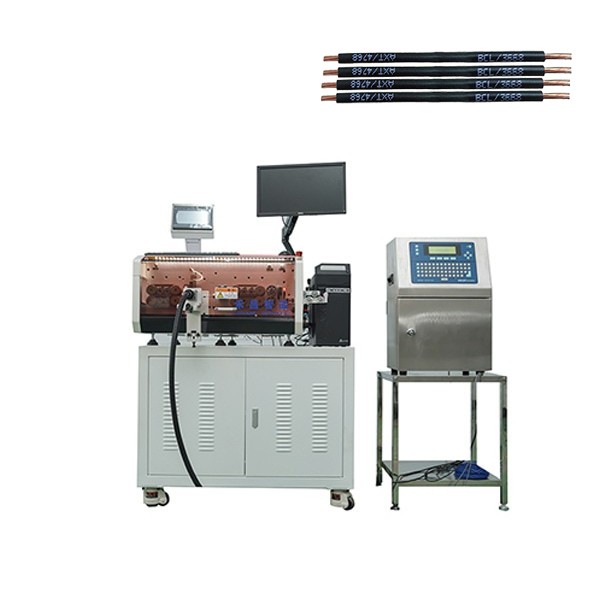
Electronics manufacturing covers a wide spread of wire sizes. General electronic harnesses run from about 30 AWG to 10 AWG. Smaller gauge saves space and weight. Larger gauge lowers resistance and improves robustness. High-current paths go beyond 10 AWG, where ampacity depends on the standard, the datasheet, the terminal rating, and derating rules.
Application | Typical Wire Gauge (AWG) | Notes |
|---|---|---|
General electronic harnesses | ~30–10 AWG | Smaller gauge saves space/weight; larger gauge lowers resistance |
High-current applications | Larger than 10 AWG | Ampacity governed by standard, datasheet, terminal rating, derating |
Signal lines | ~24 AWG | Finer wire for flexibility and compact routing |
Power / high-current paths | 16 AWG or larger | Sized to handle load safely |
Insulation choice follows the same logic. PVC suits economical, general-purpose wiring. XLPE adds heat, abrasion, and chemical resistance. ETFE and other fluoropolymers give thin-wall, lightweight, chemical-resistant builds for higher temperatures. Silicone stays flexible across a broad temperature range, and PTFE serves demanding temperature and chemical exposure.
Insulation Material | Key Characteristics / Typical Use |
|---|---|
PVC | Economical, general-purpose wiring |
XLPE | Improved heat, abrasion, and chemical resistance |
ETFE / fluoropolymers | Thin-wall, lightweight, chemical-resistant, higher-temperature |
Silicone | Flexible across a broad temperature range |
PTFE | Demanding temperature and chemical exposure |
Signal lines often use finer wire, such as 24 AWG, for flexibility and compact routing. Power lines or high-current paths may require 16 AWG or larger to handle the load safely.
PCB assembly and connector wiring also include custom cable assemblies for information and communications technology. These builds mix fine signal leads with heavier power conductors in one harness. A wire cutting stripping machine must switch between gauges without losing strip accuracy. Connector wiring adds a second constraint. Each lead must reach the terminal at the right length, and the strip window must expose enough conductor for a reliable crimp or solder joint. A short strip leaves too little metal for the joint. A long strip exposes bare conductor outside the terminal. Both faults surface later as intermittent connections. Production volume shapes the choice as well. Prototype shops run short batches and change setups often. High-volume plants run the same cable for hours and value stability over flexibility.
Internal cabling and specialty wires
Internal device cabling brings its own set of wire types. Flat cables need clean, parallel strips across many conductors at once. The HECHANG HC-515G targets this flat-cable work. Ultra-thin wires from AWG24 to AWG36 demand delicate blade control, and the HC-515H1 covers that range. Multicore cables up to 35 mm² call for the HC-608K1, which handles several conductors in one jacket. Multi-layer stripping suits cables with more than one insulation layer, and the HC-608XZ performs automatic multi-layer cutting and stripping.
Each specialty wire type places a different demand on the blade. Flat cable needs even pressure across the width. Ultra-thin wire needs a shallow cut depth. Multicore cable needs the blade to stop at the right layer. Multi-layer cable needs programmed depth steps. Matching the model to the wire type prevents core damage and scrap.
Selective stripping needs add two more options. The HC-515B+T combines stripping and twisting in one pass, which saves a separate operation. Rollover and micro stripping remove only a short window of insulation, so a conductor can be tapped mid-run without cutting the wire. These methods suit dense device interiors where space is tight and every millimeter of insulation counts.
Shared benefits across both industries
Precision, speed, and cost efficiency
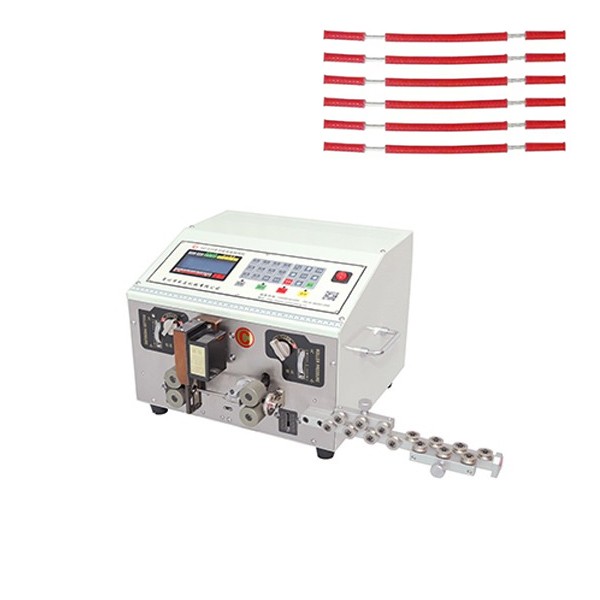
Automated precision cutting and stripping deliver identical results on every wire. This consistency lowers the risk of errors that could compromise quality or functionality. Fewer mistakes and less rework translate into material and cost savings. Cutting to exact lengths keeps output specification-compliant and avoids excess material usage from over-length cuts. Clean insulation removal, with the slug left intact, prevents fraying and reduces scrap and rejected terminations.
Mechanism | Quality Contribution | Waste Reduction |
|---|---|---|
Automated precision cutting and stripping | Identical specifications on every wire | Fewer mistakes, less rework |
Cutting to exact lengths | Consistent, compliant results | No over-length material use |
Insulation stripping with intact slug | Clean, professional results | Less scrap and fewer rejects |
Speed compounds these gains. A wire cutting stripping machine runs repeatable cycles without operator fatigue, so throughput holds steady across a full shift. Labor shifts from manual stripping to loading, monitoring, and changeover. That shift lowers labor costs and raises cable processing quality at the same time.
Sustainable manufacturing demand is pushing stripping machine makers toward energy-efficient designs with reduced material waste. Modern systems optimize blade performance, minimize insulation scrap, and consume less electricity through efficient drive technologies.
Safety and scalability
Consistent stripping reduces handling errors. Automated machines cut manual intervention in repetitive and hazardous wire processing tasks. This decreases workplace injuries and helps ensure compliance with safety standards. Electronics work benefits too, where automated machines handle intricate harnesses with high precision and support miniaturization. EV production adds its own demand for high-voltage cable processing with enhanced safety features and minimal manual input. Compliance with UL and IEC standards further confirms that processed cables are safe and effective.
Scalability follows the same logic. Semi-automatic benchtop units suit medium volume and flexible batches. Fully automatic systems reach high-volume production rates. A facility can start with one machine on a single line and add identical units as demand grows. Operator training transfers across models, which shortens ramp-up for new employees. High-quality components support stable long-run operation and lower maintenance costs over the life of the equipment.
Choosing the right machine
Performance and application fit
The application decides the machine. Start with wire size and type range. A harness shop running 22 AWG sensor leads needs different capacity than a plant processing 240 mm² battery cables. The table below shows how gauge tracks with current and use.
Wire Gauge (AWG) | Metric Size (mm²) | Typical Current Rating (A) | Common Application |
|---|---|---|---|
22 | 0.34 | 5–7 | Signal transmission and sensors |
20 | 0.50 | 8–10 | Low-power control circuits |
18 | 0.75 | 10–15 | Standard I/O and PLC wiring |
14 | 2.50 | 20–25 | Power distribution and motor leads |
Stripping layers matter too. Multi-layer cable needs programmed depth steps, and the HC-608XZ covers that work. Flat cable suits the HC-515G, ultra-thin AWG24–AWG36 wire suits the HC-515H1, and multicore cable up to 35 mm² suits the HC-608K1. Large cable fits the HC-608L2, HC-608XL, or HC-608EX depending on size. Each model type fits a specific job best.
Compliance and cost
Automotive and electronics work carries compliance duties. Buyers should confirm UL and IEC conformity for the cables they process. A 300V-rated part will not serve a 600V circuit, so voltage rating must match the application.
Total cost reaches beyond the purchase price. Industrial-grade automatic machines run $3,000–$10,000+, while benchtop electric units sit at $500–$2,099. Blades need replacement or sharpening roughly every 100,000 cycles, and feed rollers, guide tubes, and belts wear over time. A well-built wire cutting stripping machine may cost more upfront and still deliver lower lifetime cost through fewer breakdowns and steadier uptime. Buyers should weigh warranty length, spare parts availability, and service support against the sticker price.
Wire cutting stripping machines serve distinct but overlapping roles across both industries. Automotive work centers on harness production, sensor leads, and EV battery cables. Electronics work centers on connector assembly and internal device cabling. Each path rewards the same discipline: match machine capabilities to wire range, stripping layers, compliance needs, and cost targets.
That match decides value in either industry. A well-chosen wire cutting stripping machine holds tolerance, supports long runs, and keeps lifetime costs predictable.
Wiring complexity keeps rising. EV platforms move toward 800V architectures, and surface-mount devices held 81.6% of 2024 electronics revenue. Both trends reward precise wire preparation.
FAQ
What does a wire cutting stripping machine actually do?
It cuts wire to a set length and removes insulation from the ends. Motors and sensors drive the blades and feed the wire. The machine holds length tolerance near ±0.5 mm to ±1.0 mm and strip tolerance near ±0.3 mm. Clean strips protect the metal core.
How does automotive work differ from electronics work?
Automotive lines focus on harness leads, sensor wiring, and EV battery cables. Electronics lines focus on connector wiring and internal device cabling. Automotive work leans toward larger gauges and high-voltage safety. Electronics work leans toward fine signal wires and flat or multicore cables.
Which model fits which wire type?
The HC-608L2, HC-608XL, and HC-608EX serve large cables up to 120 mm², 150 mm², and 240 mm². The HC-515G handles flat cable. The HC-515H1 covers ultra-thin AWG24–AWG36 wire. The HC-608K1 suits multicore cable up to 35 mm². The HC-608XZ performs multi-layer stripping.
How fast can a machine run?
Semi-automatic benchtop units process medium-volume batches. Fully automatic systems reach high-volume production rates. A facility can add identical units as demand grows, and operator training transfers across models.
What maintenance and compliance points matter?
Blades need replacement or sharpening roughly every 100,000 cycles. Feed rollers, guide tubes, and belts wear over time. Buyers should confirm UL and IEC conformity and match voltage rating to the circuit. Spare parts availability and service support protect uptime.


View More(Total0)Comment lists