


How to choose the right wire cutting stripping machine for manufacturing
 Nov 10, 2026|
 View:15
The right wire cutting stripping machine depends on eight core criteria: wire types and sizes, stripping method and accuracy, the feeding and cutting system, automation level, throughput, quality control, total cost of ownership, and supplier support. Buyers who match these criteria to their actual production requirements make better decisions than buyers who shop on price or brand alone. A low-cost unit that cannot handle the wire mix, or a premium brand that exceeds the needed volume, both waste money. This guide presents a step-by-step selection process. It ends with a practical checklist for evaluating any candidate machine before purchase.
Key Takeaways
List your wire types and sizes first. This step helps you find a machine that fits your actual production needs.
Match the stripping method to your wire. Blade stripping works for standard wire. Rotary stripping handles thick or layered cables.
Choose the automation level based on your volume. High volume justifies automatic machines. Low volume may only need semi-automatic ones.
Consider total cost, not just price. A reliable machine with low downtime often saves more money over time.
Test the machine with your own wire before buying. A sample trial shows if the machine meets your quality and speed needs.
Define Requirements for Your Wire Cutting Stripping Machine
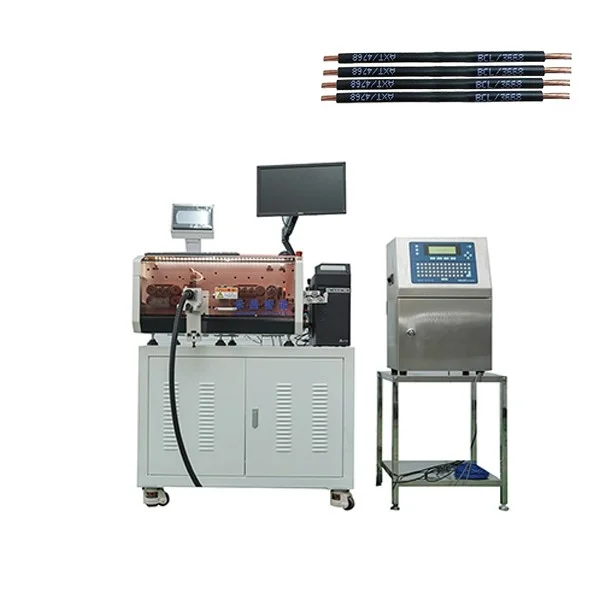
A requirements document comes before any machine comparison. Buyers who skip this step end up comparing catalogs instead of comparing machines to their own production. The exercise has two parts: a wire inventory and an output estimate.
Catalog wire types and sizes
Start with a written inventory of every wire the shop processes. Record conductor size, insulation material, outer diameter, and construction. Hechangmachinery notes that wire processing depends on the combination of conductor size, insulation material, cable construction, and feeding behavior. The gauge should be one of the first inputs when specifying stripping equipment.
Several distinctions matter at this stage:
Solid versus stranded construction. A machine designed for solid wire may struggle with flexible stranded conductors.
Insulation thickness. Thick insulation on high-voltage cables needs deeper cuts and more blade travel. Thin insulation on delicate signal cables needs gentle handling to avoid conductor damage.
Layer structure. Shielded cable may carry multiple layers. The stripping sequence and layer structure belong in the selection discussion, and accuracy must hold at more than one depth.
The size span is often wider than buyers expect. A single plant may run fine-gauge wires alongside large cables. One machine rarely covers that full span. Rotary stripping machines such as the Hechang HC-100B, HC-200B, and HC-300B handle a 10mm to 50mm diameter range, which suits one band of the mix. Industrial harnesses often combine mixed wire specifications, so repeatability and stable feeding matter when one machine sees several wire types.
Wire Type / Size | Detail |
|---|---|
Solid vs stranded | A machine designed for solid wire may struggle with flexible stranded conductors. |
AWG examples | 14 AWG solid wire and 8 AWG stranded cable |
Diameter range (HC-100B, HC-200B, HC-300B) | 10mm to 50mm |
Insulation thickness | Thick insulation needs deeper cuts; thin insulation needs gentle handling. |
Estimate output and changeovers
Output volume decides the automation level. Hechangmachinery suggests a simple method: divide available production hours by the daily output target. A line that must build 2,000 harnesses per day across one eight-hour shift needs 250 units per hour. That figure quickly shows whether semi-automatic or fully automatic equipment makes sense.
Annual volume sets the floor. A manufacturer processing around 10,000 wires per year will find manual processing too time-consuming and should consider a machine. Changeover frequency shapes the choice as much as raw speed. Low-volume, high-mix production demands flexibility, and changeover time matters more than cycle time when the shop runs many small batches. High-volume, standardized products justify full automation. Shortening changeovers from forty minutes to under fifteen minutes substantially increases daily machine availability, according to Taizhengmachine. Buyers should log current changeover duration and batch sizes before they compare wire cutting stripping machine options.
Match Machine Capabilities to Your Wire
Compare stripping methods and accuracy
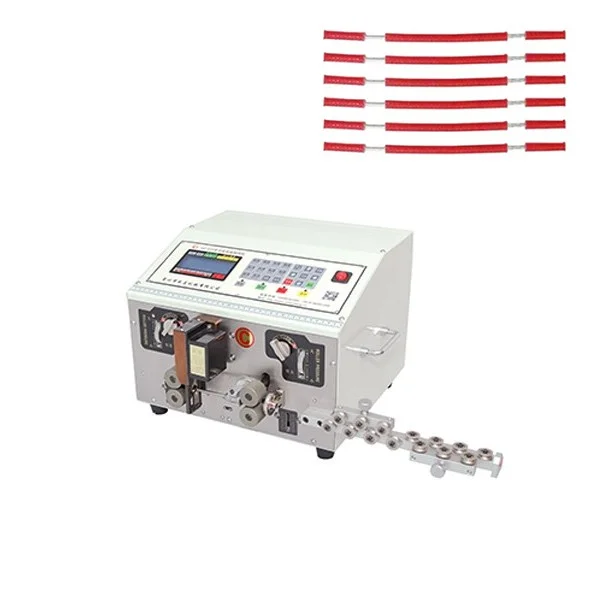
Two stripping methods dominate the market, and each fits a different job. Blade stripping uses opposing blades to cut the insulation and separate the stripped section from the wire. This method suits conventional single-core wire and many standard cable applications where the insulation is compatible with the tooling. It delivers fast, repeatable cycles in high-volume production within the machine's rated range. Rotary stripping uses a rotating cutting head that works around the circumference of the cable. This method fits cables with a thick or tough jacket, a large diameter, several layers, or a shield that needs controlled exposure. Large-section EV, industrial, and high-voltage cables often call for rotary processing, because stiffness and jacket construction make conventional blade processing less suitable, according to EW Wire Stripping.
Accuracy separates a good machine from a frustrating one. Machines used in wire cut and strip processing deliver highly accurate results, ensuring every wire is cut and stripped to the exact same specifications, which reduces the risk of errors, notes Intwirecable. Every wire processed goes through rigorous quality checks to ensure it meets specifications. Servo wire feed holds wire length control to plus or minus 0.1 mm, and auto blade calibration self-adjusts blade depth based on real-time conductor detection, per Sttellardawang. Reject detection automatically identifies and ejects out-of-specification wires. Operators can tune results with a simple routine: increase blade depth slightly when leftover insulation appears, reduce it when the metal shows cuts, then inspect for a clean strip and no wire damage.
Evaluate feeding and wire protection
The feeding mechanism protects the wire as much as it moves it. Synchronous belt drive feeding ensures a firm grip without leaving marks or deforming the wire, according to Wire-Processor. Synchronous belts spread pressure evenly along the cable surface, and this gentle method prevents pinch marks and surface damage on soft insulation jackets during high-speed production runs.
Clamping deserves equal attention. Pneumatic cylinders operate wire clamps, auxiliary stripping mechanisms, and wire-release devices, providing repeatable linear movement and adjustable force, notes BLPneumatic. Motor-driven rollers or another controlled feeding system typically establish wire length. Clamping force must be selected carefully. Too little force may allow the wire to slip and affect strip length. Too much force can deform insulation or damage delicate cable structures. Jaw geometry, contact material, and contact area matter as much as cylinder size. Machines processing multiple wire diameters or insulation materials may need adjustable pressure regulation or different clamp settings, established by trials with the actual wire.
Cutting accuracy and process options complete the capability picture. Buyers should confirm cutting accuracy alongside the feeding system on any wire cutting stripping machine under review. Twisting and tinning stations suit shops that prepare stranded ends. Flat and ribbon cable processing covers ribbon stripping and cutting. Terminal crimping compatibility matters when the process includes terminating wires. Crimping force and force monitoring support quality control, and quick-change applicators or dies let one machine handle many terminals. High-mix environments benefit from flexible, programmable systems, according to Kingxoul.
Evaluate Automation and Throughput
Semi-automatic vs. fully automatic
Automation level should follow volume and labor constraints, not preference. Manual tools fit very low volume, repairs, and prototypes. Semi-automatic machines suit small batches, mixed jobs, and lower investment, because the operator still feeds or positions each piece. Pneumatic strippers sit in the same band: they remove hand fatigue and speed up repetitive stripping, yet they still depend on an operator for every wire. Fully automatic cut and strip systems fit repeat production with many pieces per shift.
Type | Operator Involvement | How It Works | Typically Suits |
|---|---|---|---|
Manual | High | The operator measures, cuts and strips by hand. | Very low volume, repairs and prototypes. |
Semi-Automatic | Medium | The operator feeds or positions each piece, and the machine performs part of the cutting or stripping process. | Small batches, mixed jobs and lower investment. |
Automatic Cut and Strip | Lower | The machine feeds, measures, cuts and processes the wire according to a stored program. | Repeat production, many pieces per shift and consistent processing. |
The throughput gap is large. EW Wire Stripping notes that a skilled operator might strip 200 to 400 wires per hour by hand, while an automatic machine processes 2,000 to 8,000 wire ends per hour. That difference reshapes the labor plan. One operator can supervise several automatic units, and Sttellar Dawang reports an operator-to-machine ratio that improves from 1:1 to 1:3 or better.
Q: What is the difference between a semi-automatic and an automatic wire stripping machine?
A semi-automatic machine requires the operator to feed or position each piece, while an automatic cut and strip machine feeds, measures, cuts and processes the wire according to a stored program. Automatic machines are generally suited to repeat production with many pieces per shift.
Throughput and line integration
Cycle time alone does not define throughput. Buyers should weigh cycle time against changeover time, uptime, and scrap. A wire cutting stripping machine with fast cycles but frequent stoppages delivers less than a slower unit that runs steadily. Dual-end stripping in a single pass halves the processing steps, and programmable strip lengths hold insulation removal to within plus or minus 0.5 mm, per Sttellar Dawang.
Line integration separates a bench tool from production equipment. PLC interfaces compatible with MES connectivity, conveyor feed compatibility, and data output for quality traceability let the machine report into the wider system. Higher-volume lines benefit from wire pre-feeders and collectors, which keep the machine supplied and remove finished bundles without an operator. Hechangmachinery frames the choice as a scaling decision: machines add output through capacity and shifts, while manual work adds output through hiring and training. A shop that doubles its orders must otherwise double bench space and payroll.
Assess Quality, Reliability, and Total Cost of Ownership
Quality checks and maintenance
Quality verification starts with the blade. Hechangmachinery reports that servo-driven systems hold blade radial feed depth to micron-level accuracy and stop precisely before the conductor surface. Depth control tolerance reaches ±0.01 mm, compared with variable human accuracy. Multi-layer cables benefit from up to 9 programmable stripping steps in a single cycle. The payoff shows in defect rates: below 0.1% for servo-driven systems against 3% to 8% for manual stripping methods.
Practice / Metric | Value |
|---|---|
Blade radial feed depth control | Micron-level accuracy, stopping before the conductor surface |
Depth control tolerance | ±0.01 mm |
Multi-layer processing | Up to 9 programmable stripping steps per cycle |
Defect rate (servo-driven) | Below 0.1% |
Defect rate (manual) | 3% to 8% |
Buyers should confirm build quality before purchase. Hechangmachinery notes that CNC-machined parts produce tight tolerances, and an in-house testing lab verifies blade precision and durability before assembly. Every machine undergoes 100% electrical testing before packaging. Certifications such as ISO 9001, CE marking, and TUV verification give further assurance.
Maintenance demands stay modest. VEVOR recommends cleaning debris after each use, lubricating blades, rollers, and pivot points weekly with light machine oil or silicone spray, and inspecting blades for nicks or uneven edges. Slightly dull blades take a sharpening; chipped, bent, or rusty blades need replacement. A simple inspection routine catches problems early: increase blade depth slightly when leftover insulation appears, and reduce it when the metal shows cuts.
Purchase price vs. lifetime costs
Purchase price is only the first line of the cost sheet. A complete total cost of ownership calculation adds consumables, labor, and downtime. Blades wear and need replacement; armored cable work uses SKD-11 high-carbon alloy steel blades, and the standard configuration includes 10 rotary blades and 2 fixed blades. Buyers should price a year of blade consumption against their wire volume.
Labor and downtime usually outweigh consumables. A machine with a low sticker price but frequent stoppages erodes savings through lost output and idle operators. Buyers should ask suppliers for uptime data and spare-part lead times, then weigh those against the purchase price. The lowest total cost often belongs to the wire cutting stripping machine that runs steadily, not the cheapest one on the quote sheet.
Select a Reliable Wire Cutting Stripping Machine Supplier
Supplier evaluation criteria
A supplier's support system matters as much as the machine itself. Kingxoul advises buyers to look beyond the purchase price and weigh tooling costs, blade and die availability, energy use, and expected lifespan. Training, spare parts, and local service belong on the same list. Scalability deserves a question too: can the machine grow with production?
Range coverage shows whether one supplier can serve the whole wire route. Sedeke notes that a complete project may include machines, applicators, tooling, feeders, inspection equipment, spare parts, and training. The HECHANG lineup illustrates this breadth. It spans a fully automatic series, terminal crimping machines, pneumatic strippers, and wire pre-feeders and collectors. Specific models cover specific jobs: the HC-608 series handles big cables, the HC-515 series serves small to medium wires, the HC-515B+T strips and twists, and the HC-515G cuts flat cable. A buyer who sources several of these from one supplier gains consistent spare parts and service contacts.
Trials and pre-purchase checklist
A sample trial answers the real purchasing question. Sedeke recommends testing the machine with the exact wires and terminals, then confirming changeover time, safety features such as guards and emergency stops, software interface and data export, and warranty terms. Buyers should bring actual wire, terminal reels, and drawings to the demonstration. Engineering should approve any challenge samples, and the trial should stay within the equipment's operating instructions.
Trial check | Question to answer |
|---|---|
Approved reference parts | Does the setup produce the required strip and crimp? |
Changeover plus production run | Can the setup be restored and accepted parts produced consistently? |
Output record | Does the figure cover loading, inspection, stops, and changeovers? |
Sedeke also suggests asking every supplier to test the same representative jobs and report the same measurements. A sample that only looks acceptable in a photograph does not establish process capability. Buyers should compare output under one shared job definition before they commit to any wire cutting stripping machine.
Selection follows a clear sequence. Buyers define their wire mix and output first, then match machine capabilities to those wires. They weigh automation against volume and labor, assess quality and total cost of ownership, and finally validate the supplier through trials and a checklist.
The right wire cutting stripping machine fits the reader's specific wire mix, volume, and accuracy needs at the lowest total cost of ownership. No single model suits every shop.
Buyers should run a sample trial with their own wire before committing. The checklist turns that trial into a documented comparison. A purchase backed by both carries far less risk.
FAQ
Can one machine handle both ultra-thin wires and large cables?
Rarely. A single unit seldom covers the full span from fine-gauge wires up to large cables. Buyers should map their wire inventory first, then confirm each candidate machine's rated range. Shops with a wide mix often pair a small-wire model with a big-cable model such as the HC-608 series.
How much annual volume justifies buying a machine?
A manufacturer processing around 10,000 wires per year will find manual processing too time-consuming and should consider a machine. Below that level, manual tools or pneumatic strippers may still fit. Buyers should divide available production hours by the daily output target to size the automation level.
Should a shop choose blade or rotary stripping?
Blade stripping suits conventional single-core wire and standard cable in high-volume runs. Rotary stripping fits thick jackets, large diameters, multiple layers, or shielded cable. Buyers should match the method to their actual wire construction rather than treating either method as universally better.
What should a sample trial prove before purchase?
The trial should use the buyer's own wire, terminals, and drawings. It should confirm strip quality without conductor damage, changeover time, safety features, and consistent output across a production run. Buyers should ask every supplier to test the same representative jobs and report the same measurements.
Why does supplier range coverage matter?
A supplier with broad coverage serves the whole wire route. The HECHANG lineup spans a fully automatic series, terminal crimping machines, pneumatic strippers, and wire pre-feeders and collectors, including the HC-515 series for small to medium wires and the HC-515B+T stripping and twisting machine. One source means consistent spare parts and service contacts.
I want to comment
Recent News
1.What is an Automatic Wire Cutting Stripping Machine?
2023-10-242.What is wire cutting stripping machine
2025-02-193.how to make a wire cutting stripping machine
2025-04-284.Where to buy automatic wire cutting stripping machines online
2026-06-105.How much does a wire cutting stripping machine cost
2026-08-146.Wire cutting stripping machine applications in automotive and electronics manufacturing
2026-10-21


View More(Total0)Comment lists